Where is Location of Ho Chi Minh Complex?
Ho Chi Minh Complex is located in Ba Dinh Square, city center of Hanoi. It is one of the most visited Tourist Attractions in Hanoi and Vietnam, and is always on the list of must visit on any itinerary of Hanoi City Tour. Being there, travelers can learn numerous things about Uncle Ho’s life, together with the history of Vietnamese liberation process under leadership of Ho Chi Minh. For the first time travelers to Hanoi, read this article before you go.
What to Do & Places to Visit in Ho Chi Minh Complex:
Ba Dinh Square:
After the French colonialists took the control of Northern Vietnam and set up their colonialist govermment in the north. They shose this area as the political center of Tonkin/the North, and then Indochinese Federation. Therefore, in these days, people can still see a number of large buildings constructed in French architecture there, which used to be the leading colonial offices of the French government.

After the August Revolution and the defeat of Japanese, Ho Chi Minh and his fellow took over the whole country, renamed this area as Ba Dinh Square. Ba Dinh, which means “Three Communal Houses”, was originally a village’s name in Thanh Hoa, in which the first war against French colonialists took place. After independence, Communist people gave the square this name as a memorial.
On 2nd September 1945, Ho Chi Minh proclaimed Independence Declaration in Ba Dinh Square, marking the establishment of the Democratic Republic of Vietnam. After Ho Chi Minh passed away, in order to show their respect to his contribution to the nation’s freedom and to remind future generations of that historical event, Vietnamese people decided to launch Ho Chi Minh Mausoleum in the place where used to be Ba Dinh Square.

The embalmed body of President Ho lays on a bronze bed with lotus patterns (Vietnamese national flower), placed on a rock pedestal with automatic lift system (installed to transport Uncle Ho’s body in case of emergency). It preserved in a glass case, put at the center of the Mausoleum, and protected by a number of military honor guards. The atmosphere here is so cool that the embalmed body of Ho Chi Minh would not be damaged. Dress Code is required if you like to go inside the building.
Located within Ho Chi Minh Complex, this special museum took people nearly 5 years to complete and was constructed to celebrate Ho Chi Minh’s 100 years of birth. Ho Chi Minh Museum was made in the shape of a huge white flower, 20 meters in height and has 3 floors.

The ground floor is a hall with 400 seats. Which is usually used to host Vietnam’s national as well as international meetings. On the second floor, a tremendous exhibition has been displayed. Which contains more than 2000 priceless historical documents and show-pieces. Those systematically reflecting Uncle Ho’s Working Life and Vietnam’s Revolutionary Stages.
Presidential Palace:
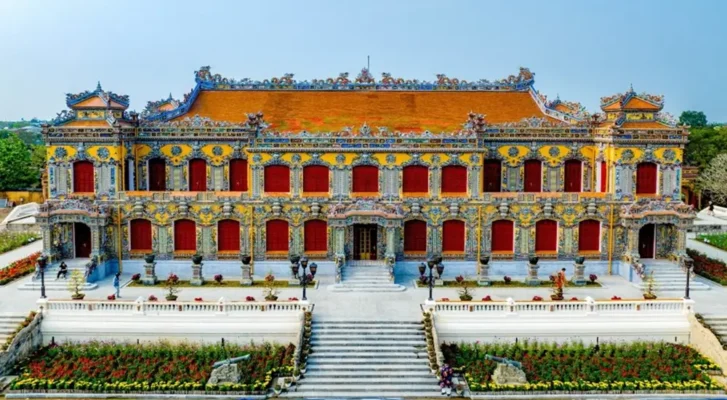
This building was designed and supervised by a German architect for the French Indochina Governor. At that time, this was the most luxurious construction with more than 30 rooms. It took approximately 6 years to complete. When the building was completed, it named “Indochina Governor Palace”. However, since the Independence Day in 1945. The name “The Presidential Palace” was given and has been used up until now.

This place was the working and living place of President Ho Chi Minh. However, Uncle Ho refused to do that. As he said it would be unsuitable for him to live in such a luxury huge building. While the other residents were poor and starving. Instead, he lived in a small house in the garden (House No.54).
The Presidential Palace was for meeting important delegations. As well as for Vietnamese young children to come and visit their beloved Uncle Ho. Nowadays, The Presidential Palace is mostly for reception to welcoming foreign national officials. As well as governments from all over the world coming to visit Vietnam.

House No.54:
This small house used to belong to an electrician, who took care of the Governor Palace. However, from 1954 to 1958, this was where President Ho lived and worked. Ho Chi Minh was famous for living such a simple life. That nearly all facilities in this house were gifts from people all over the world. According to the rumors, when people asked Uncle Ho to replace these old and out-of-date furniture. He refused as “they (the furniture) are good. And they are gifts from my friends, so nothing can compared”.
There are 3 rooms in this small house. The first is the living room, which is also President Ho’s working area. Ho Chi Minh was undeniably an extraordinary person. Thus, he had hundreds of books on numerous fields, which were neatly in this room. Visitors would also enjoy a toy on his table. Which was the present symbolizing the friendship between Vietnam and Soviet Union.

Moving on to the kitchen the second room. There was a thermometer and whenever it indicated that the temperature was under 10 Celsius degree. Ho Chi Minh would ask the Prime Minister of Education to let primary students have a day off. This regulation is still remains nowadays.
The third room is his simple bedroom. People would find a round table as a gift of Cuba’s Great Leader Fidel Castro. On which laid a Khuat Nguyen Poet Statue.
One thing travelers will be sure to have an interest in is Uncle Ho’s car collection. There are three cars, one was for travel long distances (The Pobeda, a gift from Soviet Union), one was for going around the city (The Peugeot – a present from French – Vietnamese people) and the last one, The Zis. The Zis was limitedly for the national leaders of Allies only. It has a 10-centimeter bullet-proof cover, 3 tons in weight and 6 meters in length.

Ho Chi Minh dedicated his entire life to Vietnam’s liberation. Therefore, he had no wife as well as children. Said that in the late evening. When everyone was back home and HCM finished all the work of the day. Uncle Ho would turn on the radio a gift from Hungarian students. As he “needs to hear a human voice to warm up”. For several years after moving to live and work at the stilted house. Ho Chi Minh still came back to this house for dinning and personal hygiene.
After living in House No.54 for four years, President Ho Chi Minh moved to this stilt house. The designe of this house is similar to the stilt houses in Northern mountainous areas. Which was to remind him of the arduous days preparing for the Revolution. The house has two floors, the lower one is meeting area. While the upper one has a bedroom, a study room and a bookshelf.

Walking around, visitors can feel Uncle Ho’s simple and pure lifestyle. As there are a lot of trees from various places of Vietnam. There are also fish ponds which raise anabas and golden carps. As rumours go, whenever feeding the fishes. Uncle Ho clapped his hands. And therefore the fish quickly learned the habit of hearing the sound and coming up on the surface, even long after his death.
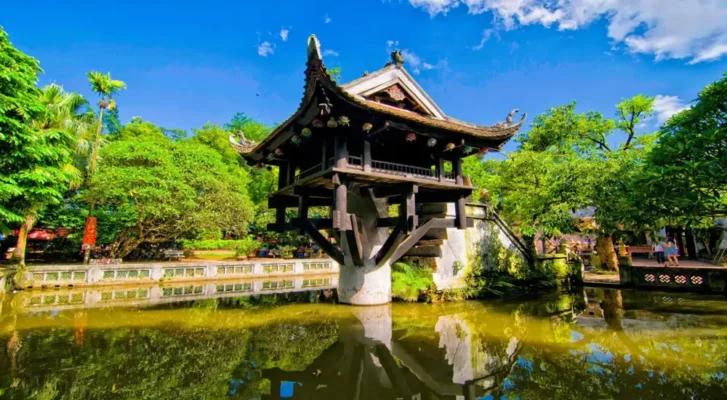
This pagoda resembles a lotus blossoming from the pond. One Pillar Pagoda had its special appearance thanks to a dream of King Ly Thanh Tong, as rumours go. Legend said that: “In the 11th century, King Ly Thai To was very old but still had no son. Thus, he went to pagodas and pagodas to pray for Buddha’s blessing so that he may get one. Until one day, he had a strange dream, in which he met Goddess of Mercy. Who was sitting on a lotus flower and gave him an intelligent son. Short time later, the queen gave birth to a nice prince. To repay to Goddess of Mercy, the King decided to construct a pagoda in the shape of a lotus flower stading on one pillar.

However, regrettably, the Pagoda being in Hanoi now is not the original one. On September 11th, 1954, the Original One Pillar Pagoda was destroyed by French soldiers. After the Independence Day, Uncle Ho required to rebuild it based on its original structure and completed in 1955. The nowadays One Pillar Pagoda is much smaller than the original one.
Directions and How to Get to Ho Chi Minh Complex:
If you use private means of transportation like car or motorbike: There are parking lots on Le Hong Phong Street. Then, go straight to Ngoc Ha street to enter Ho Chi Minh’s Mausoleum.
If you use public bus: Bus No. 09: Direction: Hoan Kiem lake – Cau Giay – Bo Ho. This bus stops at 91 – 93 Le Hong Phong street, from where you can walk to the Mausoleum ’s entrance.