

Introduction about Dong Khanh Mausoleum:
Dong Khanh Tomb (Mausoleum of Emperor Dong Khanh): Tomb of Dong Khanh offers a tranquil atmosphere amidst a beautiful natural setting and provides a unique opportunity to witness the cross-cultural interference that defines its timeless beauty. Mausoleum of Emperor Dong Khanh stands as a remarkable architectural masterpiece and a UNESCO World Cultural Heritage site. Its unique blend of traditional Vietnamese imperial design and French colonial influence makes it a fascinating reflection of a transitional period in Vietnamese history.
- Tomb Location: 8 Đoàn Nhu Hai, Thuy Xuan Village, Hue City
- Opening Hours: Daily from 7.30AM – 5.30PM
- Entrance Fee: 150.000VND/Adult
- Dress Code: Required (or you can borrow scarfs at temple’s entrances)

History of Dong Khanh Mausoleum
Emperor Dong Khanh, the ninth emperor of the Nguyen Dynasty, reigned for a mere three years before his death at the age of 25 in 1889. He died before his tomb was built, and the construction process spanned an extraordinary 35 years and four imperial reigns: Dong Khanh, Thanh Thai, Duy Tan, and Khai Dinh.
Initially, Dong Khanh began building a temple called Truy Tu to worship his father, Kien Thai Vuong, near his father’s burial site. When Dong Khanh died, the reigning Emperor Thanh Thai renamed the temple Ngung Hy Palace and used it as the main worship hall for the deceased monarch, while the emperor’s body was simply interred in a nearby hill named Ho Thuan Son. It was Khai Dinh, Dong Khanh’s son, who later renovated the temple and built the elaborate mausoleum complex around the simple burial spot between 1916 and 1923, infusing the site with the European styles he favored.
Architecture of Dong Khanh Tomb:
Mausoleum of Emperor Dong Khanh has special architecture, where East Meets West. The long construction timeline and the different personal tastes of the emperors involved resulted in a striking architectural fusion:
The Worship Area (Ngung Hy Palace):
This section retains a largely traditional East Asian architectural style. The interior is a celebrated example of Vietnamese lacquer art, featuring hundreds of gilded and lacquered panels and pillars. The decorative materials on the roof and gables, made of iridescent blue or colored glazed terracotta, represent a rare local handicraft. A notable artistic detail is the 24 stories from “The Twenty-four Filial Exemplars” depicted in the gilded interior, showcasing Emperor Khai Dinh’s filial piety.
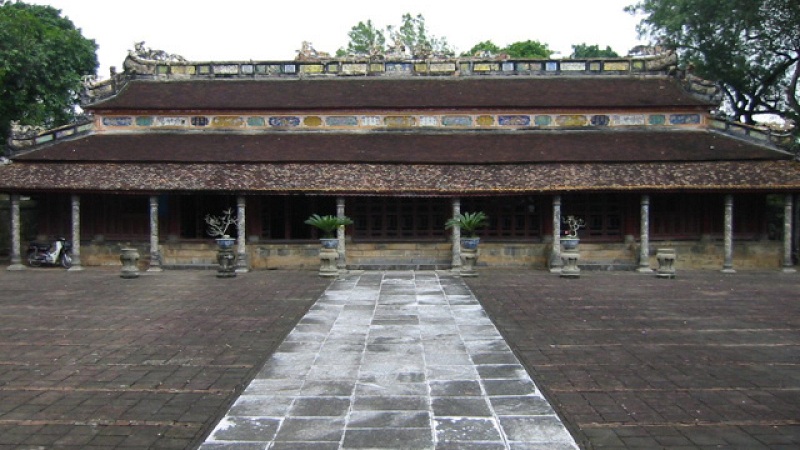
Dong Khanh Tomb (Mausoleum of King Dong Khanh)
The Burial Area (Buu Thanh):
In stark contrast, the actual tomb site, located about 30 meters west of the palace, exhibits a strong Western influence. The stele pavilion (Bi Dinh) features Romanesque architectural elements, and the statues of mandarins in the courtyard are made of brick and cement and are taller and thinner than the traditional stone statues found at other Hue tombs. This unique blend is a physical testament to a pivotal moment in Vietnamese history when the country was under French colonial control, marking the first time European architectural influences appeared in a Nguyen Dynasty royal tomb.
Visiting Information
Dong Khanh Tomb (Mausoleum of King Dong Khanh)
How to Get to the Tomb of Dong Khanh
The Tomb of Dong Khanh is about 7 kilometers southwest of the Hue city center, in Thuong Hai village, Thuy Xuan commune, close to the Tomb of Tu Duc. Here are some ways to get to the Dong Khanh Tomb:
By Private Car/Taxi:
This is a convenient option, especially for groups or families. A private car can be hired for a half-day or full-day tour of multiple tombs, with prices varying based on the itinerary. Taxis and ride-sharing services like Grab are also readily available in Hue and can take you directly to the site using a metered fare (around 15,000 VND per kilometer).
By Motorbike/Bicycle:
For those who enjoy independent exploration, renting a motorbike or a bicycle is a popular and scenic option. The route is straightforward from the city center: take Bui Thi Xuan street, then turn onto Huyen Tran Cong Chua street, and follow the signs for Tu Duc Tomb; the Dong Khanh Tomb is located just 200 meters past it on the right. Motorbike rentals are inexpensive, typically costing between 100,000 and 200,000 VND per day.
Join Private Tour:
Many local tour operators offer half-day or full-day guided tours of the royal tombs, which usually include the Tomb of Dong Khanh. A guide can provide historical context and stories, enhancing the visit.
By Dragon Boat (partial):
While a riverboat cruise on the Perfume River can take you to several major tombs’ general areas. It’s not a direct route to Dong Khanh Tomb, which is slightly inland. Ground transport will be needed for the final stretch.
Best Time to Visit the Dong Khanh Tomb:
The best time to visit the Tomb of Dong Khanh and other historical sites in Hue is during the drier, cooler months of the year for comfortable outdoor exploration.
Optimal Months (February to April):
This period offers the most pleasant weather conditions, with mild temperatures (averaging 20-27°C) and minimal rainfall. This is ideal for walking around the expansive grounds of the tomb without the intense heat of summer or heavy rains of the wet season. The Hue Festival often occurs in April during odd-numbered years, adding a cultural dimension to your visit.
Summer (May to August):
This is the hot season, with temperatures often exceeding 35°C. While the skies are typically clear and blue (great for photography), the heat can be intense, so early morning or late afternoon visits are recommended to avoid the midday sun.
Rainy Season (September to January):
This period has frequent and sometimes heavy rainfall, especially in October and November. While the rain can create a unique, atmospheric, and tranquil ambiance. It may disrupt outdoor plans. So this is best for budget-conscious travelers or those who enjoy the moody, misty scenery.
Overall, the hours between 7:30 AM and 5:30 PM are standard visiting hours for the tomb complex. And arriving early in the morning or later in the afternoon helps beat potential crowds and heat year-round.
Discover 7 Royal Tombs of Emperors in Hue:
- Tomb of Emperor Gia Long
- Tomb of Emperor Minh Mang
- Tomb of Emperor Thieu Tri
- Tomb of Emperor Tu Duc
- Tomb of Emperor Duc Duc
- Tomb of Emperor Dong Khanh
- Tomb of Emperor Khai Dinh


