Where is Location of Choeung Ek Genocidal Center?
Choeung Ek Genocidal Center: “Killing Fields” refer to numerous sites across Cambodia where more than one million people were executed and buried by the Khmer Rouge regime during its rule from 1975 to 1979. While there are hundreds of such sites, the most infamous is Choeung Ek, located approximately 15 kilometers (9 miles) south of Phnom Penh. Today, Choeung Ek is a solemn memorial site dedicated to education and remembrance.
- Address: Roluos Village, Sangkat Cheung Aek, Phnom Penh
- Opening Hours: Everyday – Time from 7:30 a.m. to 5:30 p.m
- Dress Code: Visitors must dress modestly (shoulders and knees covered), maintain silence, and avoid insensitive behavior such as taking smiling selfies.

The Killing Fields in Phnom Penh Cambodia
Historical Context of Choeung Ek Killing Fields:
- The Regime: Led by Pol Pot, the Khmer Rouge sought to transform Cambodia into a classless, agrarian communist utopia. This involved the immediate evacuation of cities and the abolition of money, schools, religion, and private property.
- Targeted Groups: The regime systematically purged anyone perceived as a “class enemy,” including intellectuals (often identified simply by wearing glasses or speaking foreign languages), doctors, teachers, ethnic minorities, and religious practitioners.
- Scale of Atrocity: Out of a total population of approximately 8 million, an estimated 1.7 to 3 million people died from execution, starvation, disease, or forced labor.
What to See in Choeung Ek Genocidal Center?
The main things to see at the Choeung Ek Genocidal Center are the central Memorial Stupa, the numerous mass graves, and various other specific historical points of interest that are detailed by an essential audio guide.
The Memorial Stupa:
This is the centerpiece of the site, a large, traditional Cambodian-style monument with clear acrylic glass panels on all sides. Inside, you will see more than 8,000 human skulls and bones, arranged by sex and age, as a tribute to the victims and a stark physical proof of the atrocities committed. Visitors are required to remove their shoes and hats before entering as a sign of respect.
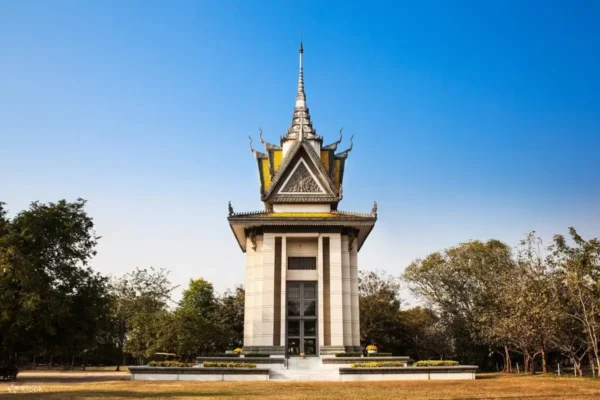
Memorial Stupa – The Killing Fields in Phnom Penh Cambodia
Mass Graves:
The site was an orchard and a Chinese cemetery before Khmer Souge used the site as an execution ground. And the depressions in the ground where people found the mass graves. While many graves were exhumed, 43 of the 129 communal graves have been left untouched. Fragments of human bone and bits of clothing still surface, especially after heavy rainfalls, and visitors are asked to notify an officer if they find any remains.

Mass Graves – The Killing Fields in Phnom Penh Cambodia
The Killing Tree:
One of the most haunting spots is a tree that the Khmer Rouge guards used to murder infants and children by smashing their heads against the trunk to avoid wasting bullets. The audio guide provides chilling context to this site.

The Killing Tree – Choeung Ek Genocidal Center
“Magic Tree” Area:
Nearby, another tree, people often call the “Magic Tree”, was where they hung a generator and speakers to play loud music to drown out the screams of the dying victims and the sounds of the executions.

“Magic Tree” – The Killing Fields in Phnom Penh Cambodia
On-site Museum and Information Panels:
The center includes a small museum and numerous information points with detailed historical context and photographs of the victims and the regime’s leaders.

Displays in Choeung Ek Genocidal Center
Memorial Ceremonies:
An annual memorial ceremony takes place at the site on May 20th to honor the victims. Audio Guide is an excellent and comprehensive audio guide, included in the admission fee, is essential for a full understanding of the site. It includes narratives from survivors and even an account from an executioner, providing personal context and depth to the physical evidence you see.
How to Get to Choeung Ek Genocidal Center?
The Choeung Ek Genocidal Center (Killing Fields) is located about 15 kilometers (9 miles) south of central Phnom Penh. Since there is no dedicated public transport. So, the most convenient ways to get there are by tuk-tuk, taxi, or a guided tour.
1. Tuk-tuk or Taxi:
- Arrangement: The standard approach is to negotiate a round-trip fare with a driver. They will drive you to the site, wait for you (typically for 90 minutes to 2 hours). And then bring you back to the city.
- Cost: Expect to pay around US$15–20 for a return tuk-tuk trip and around US$25 for a taxi. Prices depend on your bargaining skills and the distance from your hotel.
- Convenience: Many travelers arrange this through their hotel reception or use ride-hailing apps like PassApp or Grab. The recommendstion is confirm the full price beforehand.
- Combined Visits: For a slightly higher fare (around $20 for a tuk-tuk). You can also arrange to stop at the Tuol Sleng Genocide Museum (S-21) on the same trip. As the two sites offer a comprehensive historical context.
2. Organized Tours:
- Options: Both group and private tours are available, with many combining visits to both the Choeung Ek center and the Tuol Sleng Museum.
- Inclusions: Tours often include hotel pickup/drop-off, air-conditioned transport, and a professional English-speaking guide (note that site entrance fees may be separate).
3. Public Bus:
The Choeung Ek Genocidal Center is about a 30-45 minute drive from the city center. And depending on traffic and mode of transport:
- Route: The bus number is currently the 11B.
- Cost: A single journey costs a small amount (around 1,500 KHR or $0.35).
- Note: The bus is the cheapest option. But it takes longer (around 60 minutes) and the return schedule can be less reliable, potentially involving a long wait. You can track the buses using the “City Bus Official App”.
The Choeung Ek Genocidal Center is a somber but important historical site. People often visit in conjunction with the Tuol Sleng Genocide Museum (S-21 Prison) in central Phnom Penh. This was where Khmer Rouge hold the victims before transported them to Choeung Ek for execution.